
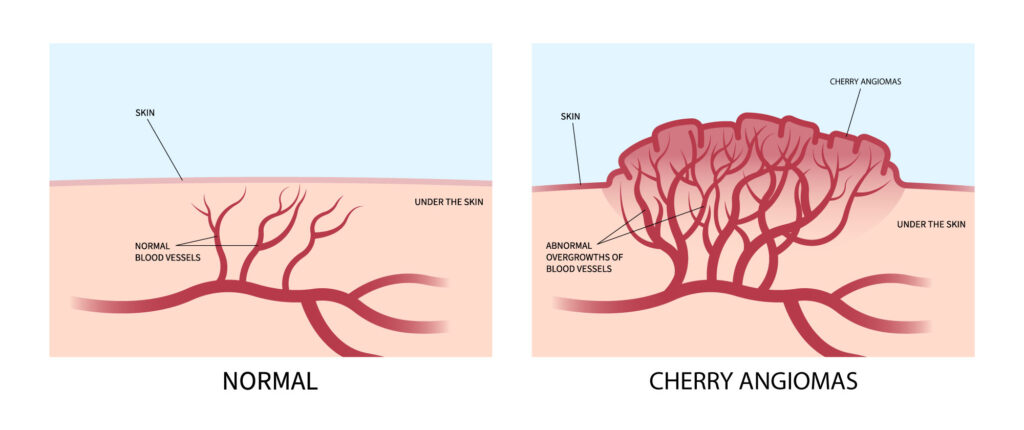
A small red dot appears on the skin, and suddenly, a person finds themselves wondering whether it needs attention or not. In most cases, that dot is a cherry angioma, one of the most common benign skin growths adults develop over time. These little spots are typically harmless, but that does not mean every cherry angioma should be ignored. Knowing what to look for, what triggers these spots, and when a doctor’s visit becomes necessary can make a real difference in catching something serious before it becomes a bigger problem.
What Is a Cherry Angioma?
A cherry angioma is a benign skin growth made up of an overgrowth of small blood vessels near the surface of the skin. They appear as bright red, dome-shaped bumps that range in size from a tiny pinpoint to about a quarter of an inch in diameter. Some remain flat, while others develop a slightly raised or rounded surface. The color can vary from cherry red to a deeper purple or even brown in some cases.
These spots tend to appear on the trunk, arms, legs, and shoulders, though they can technically develop anywhere on the body. They are most common in adults over the age of 30, and their frequency tends to increase with age. By the time a person reaches their 70s or 80s, it is not unusual for them to have dozens of these spots across their body.
Even though their somewhat alarming red appearance, cherry angiomas do not hurt, do not itch, and do not spread to other parts of the body. They also do not turn into cancer on their own. A person can have one or two, or they can develop hundreds over a lifetime. In either scenario, the spots themselves are generally not a threat to health.
What Causes Them?
The exact cherry angioma causes are not fully understood, but several factors appear to play a consistent role. Age is the strongest known contributor. As the body ages, the small blood vessels near the skin surface tend to dilate and multiply in ways they do not in younger skin. This process leads to the formation of visible clusters of capillaries that become the characteristic red bumps.
Genetics also seems to matter. People with a family history of cherry angiomas are more likely to develop them, which suggests a hereditary component to the condition. Hormonal shifts, particularly those tied to pregnancy, have also been associated with a higher rate of new cherry angioma development. Some research points to chemical and environmental exposures, including certain compounds found in industrial settings, as possible contributors.
Plus, some studies have explored connections between cherry angiomas and specific health conditions, such as liver dysfunction and certain metabolic changes. But, no single definitive cause has been confirmed across all cases. For most people, age and genetics remain the most straightforward explanations.
When Does a Cherry Angioma Need Medical Attention?
Most cherry angiomas never require any medical attention. They are benign, stable, and in the vast majority of cases, they simply sit on the skin without causing any trouble. But, there are specific situations where a dermatologist or healthcare provider should take a closer look.
The most important warning sign is a change in appearance. A spot that begins to bleed without injury, grows rapidly, changes color in an uneven or patchy way, or develops irregular edges may no longer be a straightforward cherry angioma. Any spot that shifts from a smooth dome to an irregular shape deserves professional evaluation. It is also worth noting that a true cherry angioma should not be painful. If a red spot on the skin causes tenderness, burning, or discomfort, that is a signal to seek evaluation.
A person should also pay attention to new spots that look different from existing cherry angiomas. Not every red growth on the skin is the same thing. Certain types of skin cancer, such as amelanotic melanoma, can mimic the appearance of a benign red spot. A dermatologist can distinguish between a harmless cherry angioma and something that requires further testing.
Treatment Options
For those who want to remove a cherry angioma for cosmetic reasons or because it has been repeatedly irritated by clothing or jewelry, several effective treatment options exist. None of these treatments is medically necessary unless the spot has been flagged as abnormal, but they are widely available through dermatology practices.
Electrodesiccation is one of the most common approaches. In this procedure, a fine needle delivers an electric current to the blood vessels in the angioma, which destroys the tissue and causes it to fall off within a few days. The process is quick, typically takes just a few minutes per spot, and leaves minimal scarring in most cases.
Laser therapy, particularly pulsed dye laser treatment, is another well-established option. The laser targets the hemoglobin in the blood vessels and destroys the angioma without significantly affecting the surrounding skin. Cryotherapy, in which the spot is frozen with liquid nitrogen, is also used, though it tends to work better on flat or very small angiomas rather than larger raised ones. A dermatologist can recommend the most appropriate approach based on the size, location, and number of spots a person wants addressed.
Are Cherry Angiomas a Sign of a Serious Health Condition?
This is a question many people ask, and the honest answer is: usually no, but occasionally it is worth looking deeper. The sudden appearance of a large number of cherry angiomas over a short period of time, especially in a person who had very few before, has been discussed in some medical literature as a potential indicator of internal changes worth investigating.
A few case studies and clinical observations have linked a rapid proliferation of cherry angiomas to hormonal imbalances, liver-related conditions, and elevated lipid levels. Some researchers have also noted associations between a high concentration of cherry angiomas and certain rare syndromes, though these connections remain the subject of ongoing study and are not definitive diagnostic criteria.
For the average person with a handful of stable cherry angiomas that have not changed over time, there is no reason for alarm. The body simply develops these spots as a normal part of the aging process. But, if dozens of new spots appear in a matter of weeks or months, or if the spots arrive alongside other unexplained symptoms such as fatigue, weight changes, or abdominal discomfort, a visit to a physician makes good sense.
Dermatologists consistently emphasize that cherry angiomas on their own are not a reliable diagnostic marker for serious illness. Still, the body often communicates through the skin, and any significant or sudden shift in a person’s skin patterns deserves attention rather than dismissal. Annual skin checks with a qualified dermatologist remain one of the best ways to stay on top of changes and catch anything unusual early.
Conclusion
Cherry angiomas are among the most common and least threatening skin changes a person can experience. They form as a natural part of aging, tend to run in families, and rarely require any medical intervention. That said, changes in appearance, rapid new growth, or spots that bleed or cause pain should always be evaluated by a professional. Staying informed and maintaining regular skin check-ups gives a person the best chance of catching anything unusual before it becomes a real concern.


