
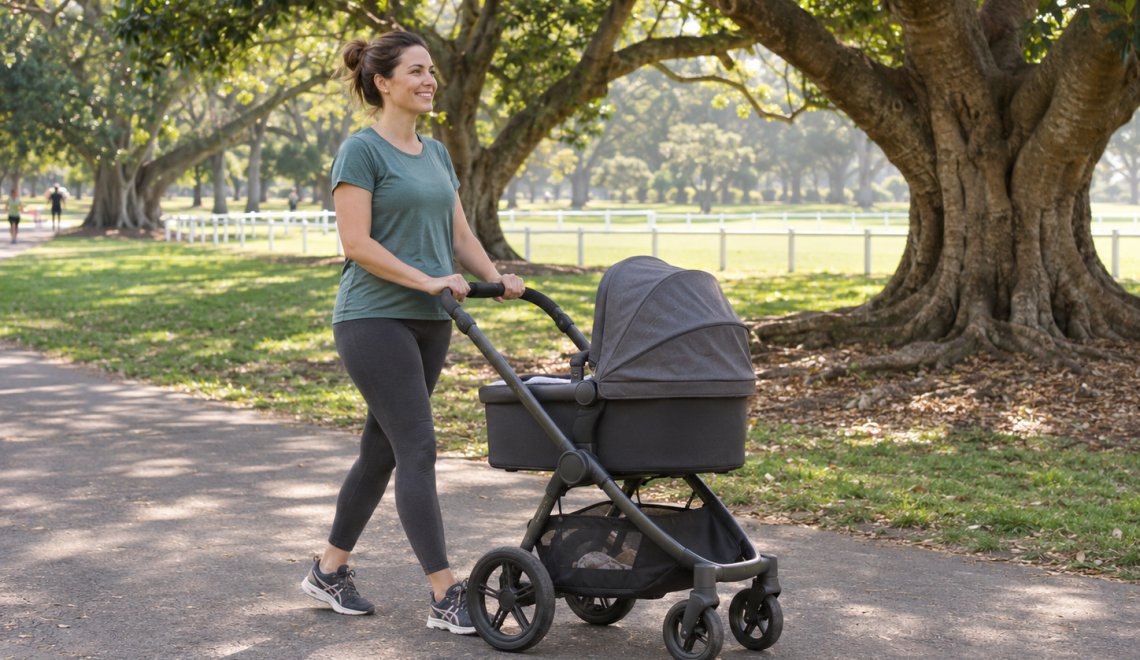
If you miss your Saturday run around Centennial Park, it’s tempting to see how a quick jog feels as soon as you get a spare half-hour. But the work that gets you ready for that first run starts with gentler movement. Here’s how to build up to it and what to do if something feels off along the way.
Our earlier article, When can I start running again?, looks at the questions that come up when you’re thinking about running after childbirth. This guide picks up with what you can do in the weeks before you start.
1. Start with a walk you can comfortably finish
When gentle walking feels comfortable and your care team says it’s appropriate, try a short, flat stroll. That might be a loop with the pram or a walk to meet a friend for coffee. Build the length or pace gradually as you recover. If you’ve had a caesarean, stitches or birth complications, ask your care team how to adapt your activity. Gentle pelvic floor and deep abdominal exercises can also be part of early recovery. A pelvic health physio can show you how to contract and fully relax your pelvic floor.
2. Make running part of your postnatal check-up
Tell your GP or obstetrician that you’d like to run again. Ask how your abdominal muscles and pelvic floor are recovering, what low-impact exercise suits you now and whether a pelvic health physio assessment would help. Pregnancy, Birth and Baby advises waiting at least three months before high-impact exercise and suggests allowing four to six months before returning to your previous activity level. Think of the first milestone as a chance to review how you’re recovering. You may need longer.
3. Check how your body handles impact
From around 12 weeks, the Royal Berkshire NHS physiotherapy guide uses several movements to assess readiness. Examples include walking for 30 minutes, balancing for 10 seconds on each leg and jogging on the spot for a minute. The full assessment also includes single-leg strength and hopping. Ask a pelvic health physio which movements are appropriate for you. If you feel pain or vaginal heaviness, or notice bladder or bowel leakage, pause before progressing to running.
4. Keep the first outing short and easy
When you’re ready for impact, choose a flat route with an easy way home. Warm up with a walk, add a short spell of slow jogging, then walk again. Build up the time or distance before working on speed. A familiar path at Centennial Park or a flat stretch of the Maroubra promenade can make it easier to turn back whenever you’ve done enough. If you’re breastfeeding, timing your outing after a feed and wearing a supportive sports bra may help you feel more comfortable.
5. Get help early if symptoms show up
A sudden urge to wee, urine or bowel leakage, a dragging feeling or bulge in the vagina, and pelvic pain are all reasons to pause running and speak with your GP or a pelvic health physio. Mention any scar discomfort that comes on with exercise too. It helps to describe when you first noticed it, whether it happened on a walk or during a jog, and how it felt afterwards.
If today’s outing is a short walk before the next feed, call it a good place to start. You can build from there at a pace that fits your recovery and your day.


