
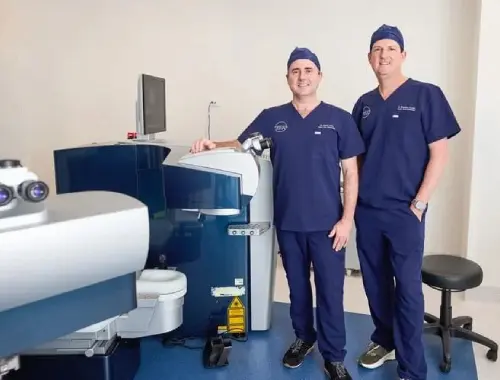
According to the Australian Institute of Health and Welfare, approximately 65.2% of Australian women aged 18 and over wear either contact lenses or prescription glasses. Moreover, other studies have shown that 59% of Australian females have a long-term vision disorder. Many of whom are over 55 and need vision correction. This is notably higher than that of men (51%).
One solution that many Eastern Suburbs mums are exploring is laser eye surgery. If this is something you are weighing up, here’s what you should know before you book.
What Is Laser Eye Surgery?
Laser eye surgery is a routine procedure that uses lasers to reshape the cornea, which is the transparent front part of the eye. It is designed to correct vision problems such as astigmatism, nearsightedness, and farsightedness, specifically by improving how light focuses on the retina.
The procedure is quick and usually painless, and reduces or removes the need for glasses or contact lenses. Many people explore professional eye surgery after years of relying on corrective lenses.
The two most common types of laser eye surgery are LASIK and PRK. Both aim to correct vision. However, they differ slightly in how the eye is treated and in how long it takes to recover. LASIK usually involves creating a thin flap on the surface of the eye. PRK works directly on the outer layer.
Appointments for both are usually performed within a day, and the actual treatment often takes only a few minutes per eye.
Is Laser Eye Surgery Safe?
Naturally, safety is a major concern for those considering laser eye surgery. Thankfully, the procedure is considered very safe as it has been performed and refined in Australia for over 35 years. Moreover, clinics conduct thorough assessments beforehand to assess a patient’s suitability.
That said, laser eye surgery can have side effects, such as dry eyes, sensitivity to light, or mild discomfort in the early stages. However, these effects usually settle as the eyes heal.
Every person’s eyes are different, which is why a proper consultation is important for understanding what to expect. Having one is also important for mums as it gives them the chance to ask questions and talk through any concerns they may have with a professional.
What’s Involved in PRK?
Photorefractive keratectomy (PRK) was developed by Dr Steven Trokel and his team in 1983. It was first performed on a human by Dr Theo Seiler in Berlin in 1987.
Essentially, the procedure goes as follows:
- Patients are given numbing drops to ensure they don’t feel any pain during the surgery. Medication may also be administered to them to help them relax.
- The epithelium, which is the top layer of the cornea tissue, is fully removed. Usually, this takes less than a minute.
- A specialised surgical tool called an excimer laser is then used to correct any irregularities within the deeper corneal tissue layers. Typically, this part of the process takes no more than a couple of minutes.
- A bandage, which is not too dissimilar from a contact lens, is put on top of the cornea. This helps the tissues beneath it to heal.
What’s Involved in LASIK?
Laser-assisted in situ keratomileusis (LASIK) was officially patented by Dr Gholam Peyman in 1989. It combined the mechanical “in-situ keratomileusis” previously developed by Dr José Barraquer with PRK’s excimer laser technology. The surgery was first performed by Dr Ioannis Pallikaris in the early 1990s. It now goes a little something like this:
- Patients are given drops to numb their eye tissues.
- Using a femtosecond laser, a small flap is cut into the epithelium. This enables the surgeon to move this layer to the side and then reshape the other layers with lasers. As it remains attached, the epithelium can easily be returned to its original position once the surgery is complete. As opposed to being fully removed, as in PRK.
- An excimer laser is then used to reshape your corneal tissues and address any issues you may have with your eye curvature.
- The flap in the epithelium is put back in its place over the rest of the cornea tissue. This allows it to heal with the rest of the tissues.
How Long Does It Take To Recover From Laser Eye Surgery?
While both procedures are very effective in permanently improving your vision, the main difference between them is the length of time it takes to recover.
Generally, when performed by an experienced, fully licensed surgeon, LASIK takes only a few days for you to see clearly. However, for PRK, the timeframe is closer to a month.
Overall, PRK is considered safer to administer and provides more effective results in the long term. Primarily, this is because it doesn’t leave a flap in your cornea. Indeed, if your eye is injured or left behind by LASIK, it can be subject to complications or even greater damage.
How Much Does Laser Eye Surgery Cost in Australia?
In Australia, laser eye surgery generally costs between $2,500 and $5,000 per eye. However, the final cost will depend on a range of factors, including the procedure you have performed on your eyes, the surgeon’s experience, and where you are based.
Unfortunately, laser eye surgery is not covered by Medicare because it is considered an elective, cosmetic procedure. However, some clinics may offer payment plans, which can make the upfront cost easier to manage.
Is Laser Eye Surgery a Good Option For Me?
If you are suffering from issues that require visual corrective surgery, both LASIK and PRK are terrific options to consider.
It is worth talking to your optometrist or eye doctor to understand the potential pros and cons of the procedure. They’ll be able to advise you on the best course of action to take based on both your eye health and overall health.
Talking of which, why not check out our post on ten considerations for family health and wellness next? You might find it a useful read.
Balancing Motherhood And Eye Care: When To Consider Laser Eye Surgery


