
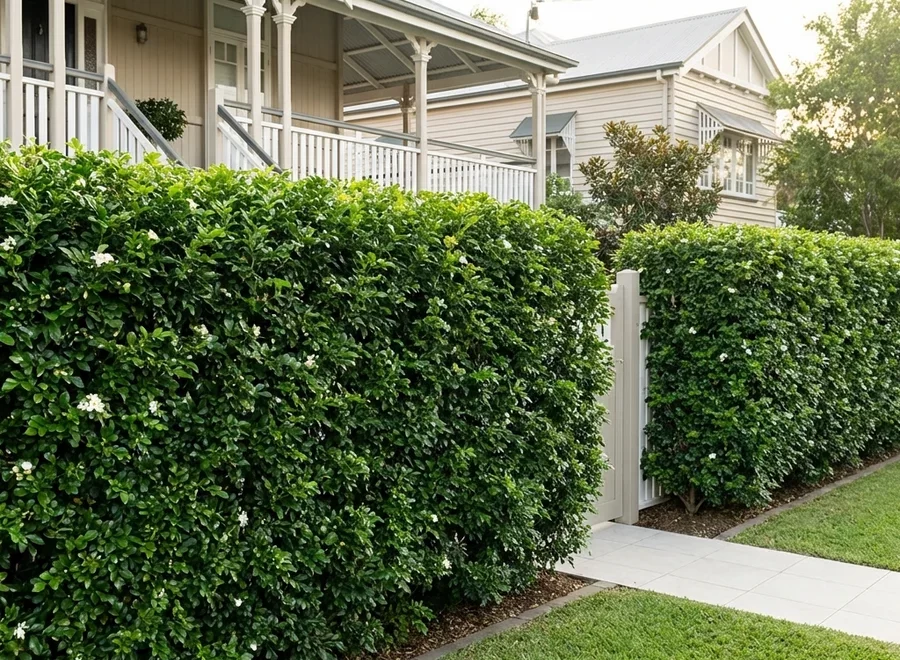
Salt wind, sandy soil and a neighbour’s window metres away: the hedges and screens that suit a small eastern suburbs garden and a busy family.
In a small garden in Randwick or Rose Bay, privacy usually comes down to one window: the neighbour’s kitchen over the back fence, or the flats a few metres from the courtyard. A fast hedge is the quick fix, and the wrong one can swallow half the yard in three years.
Before you buy, be honest about three things: how much width you can give up, how much salt wind reaches the garden, and who plays along the fence.
Width matters more than height
Screening plants are sold on height, but in a small garden the number that counts is width. A standard lilly pilly spreads about 3m if left alone. A narrow form holds itself to about a metre without constant clipping, leaving the rest of the yard for a lawn, a sandpit or the outdoor table. Choose for the spread, then set the height with the shears.
Five plants for a small coastal garden
Coastal rosemary is the hedge for a garden that faces the sea, from Bondi to Maroubra. It grows wild on clifftops along the New South Wales coast, so salt spray, wind and sand are home ground. It settles at about 1.5m tall and wide, and planted 70cm apart it makes a dense grey green hedge, a native alternative to box. Planted on the sea side, it shelters softer plants behind it. Trim it lightly three times a year, never into bare wood, which it is slow to reshoot from.
A psyllid resistant lilly pilly is the screen for most gardens a street or two back from the water. Choose one of the newer selections bred to resist psyllid, the insect that puckers the new leaves of older lilly pillies. Left alone it reaches about 5m, but two trims a year hold it at 2m to 3m, leafy right to the ground. Plant it a metre apart. For a narrow bed, the narrow lilly pilly forms reach a similar height but hold to about a metre wide. Plant them 60cm to 80cm apart and 60cm off the fence so air moves behind them.
Murraya, or mock orange, is one of the most planted formal hedges in Sydney, and the reason is the scent: white flowers that smell of orange blossom open in flushes after warm rain from spring to autumn. Unpruned it reaches about 3m tall and 2.5m wide, and it clips to any height from about 1m to 3m. Plant it beside the front path or the courtyard table, out of the direct salt wind.
Sweet viburnum suits the side of the yard that loses the sun by early afternoon. It grows in part shade, though looser than in full sun, and its thick leaves take salt wind without tattering. With water and feed it can grow close to a metre a year, and two trims a year hold it between 1.5m and 3m. It is broad, so give it the fence with the deepest bed, and thirstier than its reputation: soak it deeply twice a week through its first two summers.
Slender Weavers bamboo solves the narrow side passage. It is a clumping bamboo, not a running one, so the roots stay in a tight crown rather than coming up in next door’s lawn, and a bed 60cm wide is enough. The canes reach about 8m, and most home screens are topped at 4m to 5m. Plant it a metre apart and keep the water up in its first summer, because a bamboo that dries out while establishing drops its leaves and stalls.
You can see all five, along with narrow and compact forms of several, at nurserynearme.com.au/collections/hedging-screening.
Children and pets
The lilly pillies, coastal rosemary and Slender Weavers bamboo are not toxic to cats or dogs, and the pink berries on a lilly pilly are edible, which is one less thing to watch with a toddler about.
Think twice about photinia. Its red new growth is popular, but the leaves contain cyanogenic compounds, so it is not the plant for a boundary a dog chews along, and the clippings belong in the green bin.
Every part of oleander, still a common screen in older gardens, is poisonous to people and animals, so with small children, take it out rather than trim it. Skip running bamboo, whose runners travel under fences into the neighbour’s garden, and keep spiky yuccas and agaves away from paths and play areas.
Planting in sand and salt wind
Much of the eastern suburbs sits on sand, which drains fast and holds little water or food. Dig compost through the whole bed rather than into each hole, and mulch 75mm deep, clear of the stems.
Plant in spring or early autumn and water deeply twice a week through the first summer, then taper off. One long soak does more than a daily sprinkle.
Plant at the spacing given and no closer: tighter planting does not close the gap faster, and crowded roots fight for water in dry sand. Tip prune from the first year so the hedge branches low, and keep it slightly wider at the base than the top so it stays leafy where a ball or a dog will test it.
Choose for the width you have, put the toughest plant where the wind hits first, and a small garden can be private without being swallowed by its hedge.
Isaac Olson is the director of Nursery Near Me, an Australian online nursery.
The Invisible Cost of Coastal Living: Is Your Home Breathing In Too Much Salt?


